A Bit of History
Over the course of several centuries, the Russian Empire promulgated a series of regulations that prohibited Jews from residing in Russia. For example, in 1762 Catherine the Great proclaimed that all foreigners were permitted to live in Russia, except for Jews. But ten years later, Russia began a series of annexations of Polish territories which were home to massive Jewish populations. These Jews became subjects of the czar. The territorial transfers from Poland to Russia included much of present day Ukraine where the Kudinskys lived.
At the beginning of the 19th century, most Jews living in the Russian Empire did not have hereditary surnames. Until then, Russian Jews were generally known by their first name and a patronymic. For example Nuchem Shmuelovich and Bassie Shmuelova
were the son and daughter of Shmuel. This created administrative difficulties for the Russian government, especially in tax collections, censuses, and legal procedures.
In 1804, the czarist administration issued an edict requiring all Jews to take on an immutable hereditary family name to be used in all transactions and registers. It is likely that most Russian Jews adopted surnames over the next decade or so. The local Jewish communal authorities were responsible for the process of implementing surnames.
Jews were generally indifferent to the surnames they were forced to adopt, and ignored them except where required by law. Their surnames were systematically recorded only in civil records which were written in Russian. Most Russian Jews spoke only Yiddish and were illiterate in Russian. The spelling of the surname depended on the scribe and was therefore inconsistent.
Kudinsky
We know that four brothers and a sister who made up the oldest Kudinsky emigrant generation, were born in Bilylivka in the 1860s and 1870s and for the most part, lived there until emigrating. But it would be a mistake to assume that their roots in Bilylivka were more than two or three generations deep. The Kudinsky surname means “from Kodyna.” We can assume that before making Bilylivka their home, the family lived in Kodyna, a small town 80 km. northwest of Bilylivka. The migration from Kodyna to Bilylivka likely occurred a short time before or after 1804 when Russian law forced Jews to adopt surnames.
Various spellings of the name appear in the documents that we have found. “Kudinsky” is quite common, but “Kudinski” or “Kudinskii” more closely correspond to the Russian spelling – Кудинский.
Coodin replaces Kudinsky
“Coodin” was invented by Louis Kudinski when he emigrated in1908. He was fond of telling people that the first thing he did when he arrived in Canada was to drop the “ski.” By this act, Louis initiated the demise of the original family name barely a century after it had come into existence.
The Kudinskys who followed Louis adopted the shortened name without exception. When the last of the emigrants arrived in 1928, Kudinsky fell into disuse among our clan except for two families in Russia. Herschel Kudinsky, a son of Nesanel and Rachel, did not emigrate. He was a Kudinsky until his death sometime between 1965 and 1981. He had a son, Yasha but the son had no male descendants to continue the name.
Peisach Kudinsky, a son of Leib and Sarah, lived in Canada for only 6 years before returning to Russia in 1934 with his wife and Canadian born son Arnold Coodin. The family is “Coodin” on the ship’s passenger list but they resumed use of the Kudinsky
name in Russia. Arnold married a Russian woman and they had a daughter, Nina. The Kudinsky name survives in her patronymic, “Kudinskaya.”
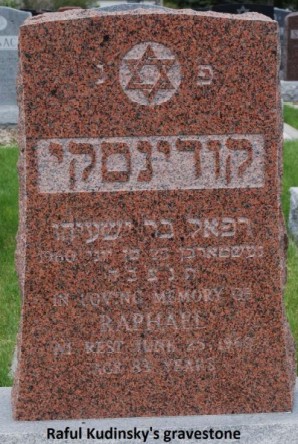
The old name flickered back to life in the 1950s when Raful Coodin once again appears in Winnipeg city directories as “Kudinsky.” His gravestone is inscribed with “Kudinsky” in Hebrew.
Tabachnick
Pinze Tabachnick is our earliest known female ancestor. She was the wife of Y’shiah Kudinsky and the mother of Herschel, Miriam, Leib, Nesanel, Raful and Feiga. “Tabachnick” means tobacco dealer in Russian and Yiddish.
The Tabachnick name was not perpetuated by the marriage of Y’shiah and Pinze as the bride took her husband’s name. But two generations later, Tabachnick entered the Coodin family tree when Pesach Tabachnick married Pinze’s granddaughter Bessie
(Passel) Coodin.
A Survey of Family Names
The origins of the surnames that appear in the first two emigrant generations of our family tree are explored below, in alphabetical order.
Applebaum
Two Applebaums married into the Coodin family. Max married Bertha Coodin and Clara married Harry Bakalinsky. The name comes from “epilboym,” Yiddish for “apple tree.”
Bakalinsky
This large branch of our family is named for the village of Bakaly in Ukraine. It is about 100 km. east of Bilylivka. Some descendants shortened the name to Back or Baklin.
Chasin or Khasin
Sarah Chasin married Leib Kudinsky/Coodin. This surname derives from the feminine given name “Khasya” which itself is a form of the Yiddish name Khana.
Chazon or Khazon
Feiga Kudinsky, the sister of Herschel, Miriam, Leib, Nesanel and Raful, was the only one of them who did not emigrate. Her married name was Chazon or Khazon. It is an occupational name meaning “cantor.”
Dresher
Bessie Dresher’s was Mottel Coodin’s first wife. “Dresher” is the Yiddish word for “thresher.”
Feldberg and Weinstein
Lily Feldberg and Mottel Coodin had both been widowed before marrying each other. “Feldberg” which was Lily’s first husband’s name, combines the German words for “field” and “mountain.” Lily’s maiden name was “Weinstein” which means “wine stone.” It refers to crystals that form when wine is fermented.
Gershuny
Eli Gershuny married Mania Coodin. In the Bible, Gershon was the eldest son of Levi.
Ginsburg
Bessie (Passel) Coodin’s birth name was “Ginsburg” before she was adopted by Raful and Chaia Bluma Kudinsky. The name refers to Günzburg, a town in the Swabia district of Germany.
Gubaty
Molly Gubaty married Percy Bakalinsky. This name means “big lipped” in Ukrainian.
Kapitz
Frances Kapitz married Sam Bakalinsky. Her name could refer to the town of Kapice in Poland, or it might come from the Ukrainian “kapitsya,” a kind of leather shoe; or the Polish “kapica,” the ridge of a roof; or the Belarussian “kapitsa,” a small hay sheaf.
Katz
Sylvia Katz married Alex Coodin. “Katz” is an acronym of a Hebrew term meaning “righteous priest.” It has been used to designate Kohanim since the 15th century.
Kohn
Sam Kohn married Bessie Coodin. Kohanim are members of the priestly caste, descendants of the priests in Jerusalem’s Temple.
Kreger
Berel Kreger married Chaykeh Coodin. “Krign” means “quarrel” in Yiddish, so the name means “quarreler.” Those Kregers who don’t want to be thought of as disagreeable, can take comfort in an alternate explanation of their name. It could be a form of “Kruger” from “krug” a Yiddish word for jug. This is an occupational name for a barkeeper.
Margolis
Libby Margolis married Dr. Pesach Coodin. The name is a rabbinical surname originally derived from a feminine given name which itself comes from the Hebrew word for “pearls.”
Meltzer
Max Meltzer married Sara Coodin. The name could come from the Yiddish word for “maltster” or from the small Ukrainian town of Mel’tsy.
Muchnik
William (Velvel) Muchnik married Laika Coodin. “Mutshnik” is the Yiddish word for a dealer in flour.
Nudelman
Nudelman appears twice in the Coodin family. It was the maiden name of Chaia Bluma who married Raful Kudinsky/Coodin. Later, it appeared in another branch of the family when Nathan Nudelman married Louis Coodin’s daughter, Zelda. Nudelman is an occupational name meaning “needle man” i.e. tailor.
Pearl
Tina Pearl married Peisach Coodin. The name, as it sounds, means “pearl” in Yiddish.
Rabinovitch
Bentsie Rabinovitch married Rose Coodin. “Rabyn” is Ukrainian for “rabbi.” The name means “Rabbi’s son.”
Richman
Philip Richman married Nellie Coodin. The feminine biblical name “Rivka” (Rebecca), has morphed into many Yiddish forms including “Rishe,” which ultimately became the root of “Richman.”
Roitman
David Roitman married Rachel Coodin. His name means “red man” in Yiddish.
Schlachter
Izzie Schlacter married Mania Coodin. “Schlachter” means “slaughterman” in Yiddish. Izzie’s ancestor would have been a shochet, a slaughterer of cattle and poultry in the ritually prescribed Kosher manner.
Shapievksi
Elka Shapievski marrid Herschel Kudinsky/Coodin. Her name means “from Shapievka,” a village in the Skvira district of Ukraine about 50 km. east of Bilylivka.
Sherman
Dora Sherman married Beryl Bakalinsky. This is an occupational name for a tailor from the Yiddish “shern,” to cut with scissors.
Simkin
Rose, a daughter of the prominent Winnipeg Simkin family, married Louis Coodin. Her name comes from the given name, “Simcha” which means “joy” in Hebrew and Yiddish.
Unikow
Rachel Unikow married Leib Coodin. “Unikel” means “cockerel” (young rooster) in Yiddish.
Winrob
Abraham Winrob married Bessie Bakalinsky. The name derives from “weintraube” which means “grape” in German.
Yanovsky
Jacob Yanovsky married Freda Bakalinsky. His name refers to “Yanovtsy,” a village in Belarus.
Compiled by Mark Kreger
Source: Alexander Beider, A Dictionary of Jewish Surnames from the Russian Empire,
Revised Edition